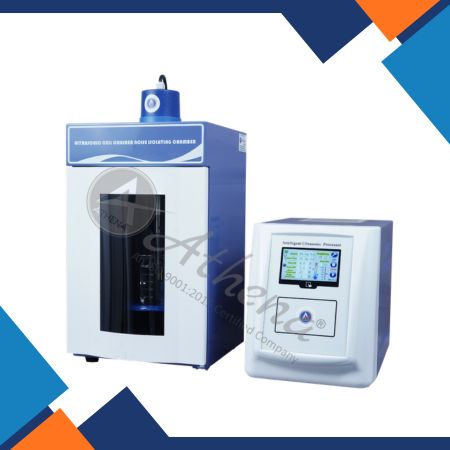
A probe sonicator does much more than just vibrate a liquid. Inside the sample, a powerful microscopic process takes place that can break cells, mix substances, and reduce particle size in seconds. Understanding how ultrasonic cavitation works inside a probe sonicator gives clarity on why this instrument is widely used in laboratories and research facilities.
From sample preparation to probe sonicator for cell disruption, the performance of the instrument depends entirely on ultrasonic cavitation in sonication. Once you understand this mechanism, selecting the right system and using it effectively becomes much easier.
The Science Behind Sonication
At its core, a probe sonicator converts electrical energy into ultrasonic vibrations. These vibrations travel through a metal probe and enter the liquid sample.
This is where the probe sonicator working principle begins. The probe oscillates at very high frequency, creating alternating pressure cycles in the liquid.
In simple terms, the liquid experiences:
- High-pressure phases where molecules are pushed together
- Low-pressure phases where tiny voids begin to form
These voids are microscopic cavities that react strongly under continuous ultrasonic waves.
How Ultrasonic Cavitation Works Inside a Probe Sonicator
The real action starts when these microscopic cavities form and collapse. This entire process is known as ultrasonic cavitation in sonication.
During operation, the following sequence happens inside the liquid:
- Ultrasonic waves create rapid pressure variations
- Tiny cavities form during low-pressure cycles
- These cavities grow over multiple cycles
- They collapse suddenly with strong force
This collapse releases concentrated energy within a very small area.
As a result, the liquid experiences:
- Localised high temperature
- Intense shear forces
- Micro-level shockwaves
These forces are strong enough to break cell membranes, disperse particles, and create uniform mixtures. This explains why the ultrasonic probe sonicator mechanism is widely used in laboratories.
Step-by-Step Working of a Probe Sonicator
To simplify the process, here is how probe sonicator works step by step:
- Energy Generation
Electrical energy is converted into ultrasonic waves through the generator. - Probe Activation
The probe vibrates and transfers ultrasonic energy into the liquid. - Cavitation Formation
Low-pressure cycles create microscopic bubbles. - Bubble Collapse
Bubbles collapse and release energy. - Sample Processing
The sample undergoes disruption, mixing, or particle reduction.
Each step occurs rapidly, allowing quick and efficient processing.
Ultrasonic Cavitation Process Explained in Table
| Stage | Activity Inside Liquid | Effect on Sample |
| Energy Transfer | Ultrasonic waves enter through probe | Molecules start vibrating |
| Bubble Formation | Cavities appear in low-pressure cycles | Initial disturbance begins |
| Bubble Growth | Cavities expand over repeated cycles | Internal stress increases |
| Bubble Collapse | Sudden implosion releases energy | Cells break, particles reduce |
| Energy Distribution | Shockwaves spread across liquid | Uniform mixing and homogenisation |
This also reflects the ultrasonic homogenizer working principle, where cavitation drives the entire process.
Why Cavitation Matters in Lab Applications
Cavitation directly affects the efficiency of your results. Strong and stable cavitation leads to faster processing and better consistency.
Applications where it plays an important role include:
- Cell lysis for protein and DNA extraction
- Emulsification of liquids
- Nanoparticle dispersion
- Sample preparation
You can improve the efficiency of your lab processes by choosing a reliable probe sonicator for cell disruption, designed to deliver consistent ultrasonic cavitation and accurate results for demanding applications.
This is why many laboratories prefer systems from Athena Instruments, where consistent performance supports repeatable outcomes.
Advantages of Probe Sonicator
A probe sonicator delivers energy directly into the sample, making it more effective than indirect methods.
- Faster processing time
- Direct energy transfer into liquid
- Suitable for tough samples
- Better control over parameters
These advantages make it suitable for both research and industrial use.
Limitations of Probe Sonicator
While effective, there are a few factors to consider:
- Heat generation during operation
- Noise during use
- Probe wear over time
- Risk of contamination without proper cleaning
Proper usage and maintenance can reduce these issues.
When to Use Probe Sonicator
Knowing when to use probe sonicator helps in achieving better results.
It is ideal when:
- Strong cell disruption is required
- Fast mixing is needed
- Particle size reduction is important
- Working with complex samples
For lighter tasks, simpler alternatives may be sufficient.
How to Select the Right Probe Sonicator
Selecting the right system depends on your application.
Consider the following:
- Power output
- Sample volume
- Probe size
- Temperature control
Choosing a trusted brand like Athena Instruments can help maintain consistent lab performance.
Practical Tips for Better Sonication Results
A few simple practices can improve results:
- Keep the probe properly immersed
- Avoid continuous long runs without breaks
- Monitor temperature closely
- Clean the probe after use
These steps help maintain both accuracy and equipment life.
Final Thoughts
Understanding how ultrasonic cavitation works inside a probe sonicator helps improve both lab efficiency and equipment selection. The process of cavitation drives powerful changes within the sample, making it suitable for a wide range of applications.
For consistent and reliable results, selecting a well-built system from Athena Instruments can support long-term performance and accurate outcomes.
FAQs
Q1. How Ultrasonic Cavitation Works Inside a Probe Sonicator?
Answer: It works by forming microscopic bubbles that collapse with force, releasing energy that breaks cells and mixes substances.
Q2. What is ultrasonic cavitation in sonication?
Answer: It is the formation and collapse of bubbles caused by ultrasonic waves in a liquid.
Q3. What is the probe sonicator working principle?
Answer: It converts electrical energy into ultrasonic vibrations that create cavitation.
Q4. How probe sonicator works step by step?
Answer: It involves energy conversion, probe vibration, bubble formation, collapse, and processing.
Q5. What are the advantages of probe sonicator?
Answer: It offers fast processing, direct energy transfer, and strong performance.
Q6. What are the limitations of probe sonicator?
Answer: Heat, noise, and probe wear are common concerns.
Q7. When to use probe sonicator?
Answer: It is used for cell disruption, emulsification, and particle reduction.
Q8. What is ultrasonic homogenizer working principle?
Answer: It uses ultrasonic cavitation to mix and break particles uniformly.