


Products
Fully Automated High-Precision Calorimetry System
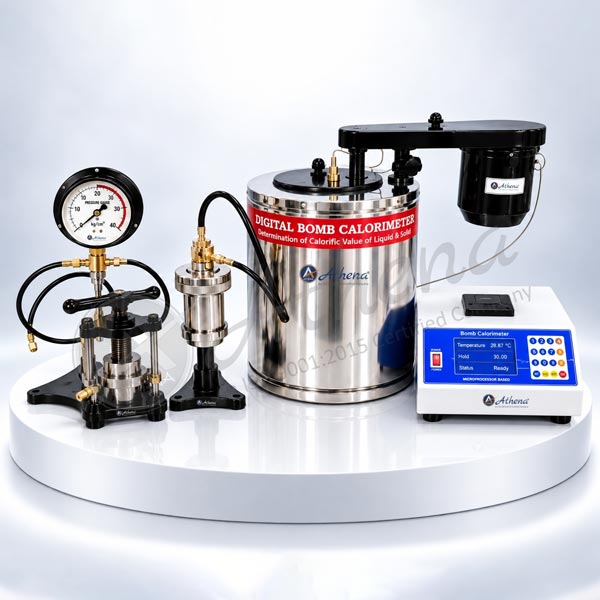
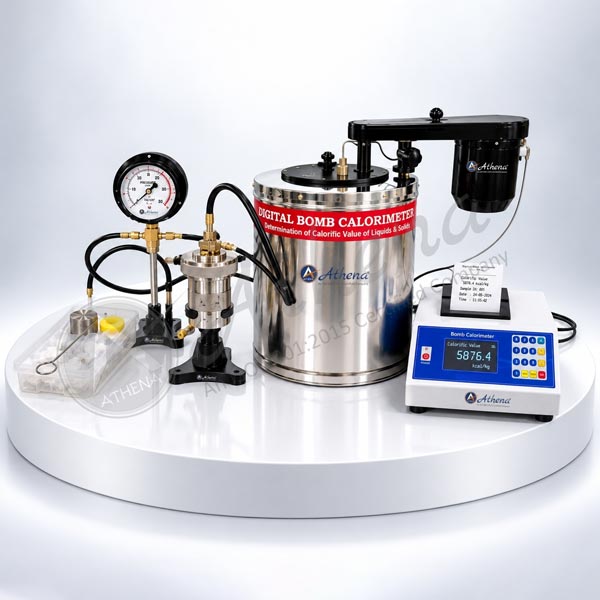
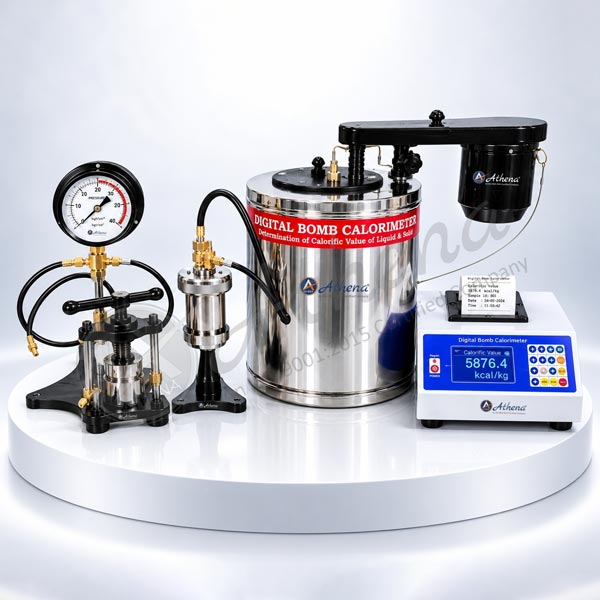
Athena Instruments introduces the Automatic Bomb Calorimeter ATH-1160, a robust and precision-engineered microprocessor-controlled system specifically designed for the accurate determination of the gross calorific value (GCV) and heat of combustion of solid and liquid fuels. Built in accordance with BS 1016 and IP 12/63 T standards, this calorimeter ensures exceptional measurement accuracy, repeatability, and ease of use across industries including petroleum, coal, chemical processing, academic research, and quality control laboratories.
Featuring an integrated thermal printer, USB connectivity, and high-resolution temperature detection, the ATH-1160 delivers fully automated analysis with minimal operator intervention. Manufactured as per BS 1016 and IP 12/63 T standards, it offers reliable, lab-ready performance with robust safety features including hydraulic pressure-tested bomb construction.
| Parameter | Specification |
|---|---|
| Display | 128 x 64 Graphical LCD |
| Keypad | 20-key tactile interface |
| Temperature Resolution | 0.001 °C |
| Power Supply | 230 V ± 10% / 50 Hz |
|
Calorific Value Measuring Range |
0 – 10,000 Kcal/kg |
| Memory Capacity | 1000 logs with date and time |
| Interface | USB port for PC connectivity |
| Printer | Inbuilt thermal printer |
| Time Clock |
Real-time clock with battery backup |





Copper (chromium-plated) or stainless steel with bomb support for stable sample positioning.
High-speed (approx. 800 rpm) belt-driven impeller ensures effective, uniform stirring without heat transfer.
Integrated digital Beckmann thermometer with automated
sample ignition and continuous temperature recording every ~30 seconds.
Each bomb is hydrotested at 300 atm (4400 psi) per Institute of Petroleum standards to ensure leak-free, deformation-controlled performance.
Stainless steel outer container with back-light cover, integrated terminal block, and water inlet/outlet for consistent thermal insulation.

Ensures highly accurate, contamination-free calorific value testing with automated calculation and reporting.
Designed for daily use with robust construction and pressure-tested safety.

Suitable for research, QA/QC, production, and academic labs across energy, petroleum, and chemical sectors.
Complete analysis outfit supplied as per BS 1016 method requirements.

Manufactured and tested under strict quality control to ensure reliable laboratory performance.
Answer: Variations may result from inconsistent sample weights, moisture, incomplete combustion, or calibration issues. Use consistent sample preparation and verify instrument performance with a suitable reference material.
Answer : Calibration frequency depends on usage, laboratory quality procedures, and the applicable testing standard. Regular verification with a suitable reference material, such as benzoic acid, helps maintain measurement reliability.
Answer: GCV includes the heat recovered when combustion-generated water vapour condenses, whereas NCV excludes this heat. NCV is generally calculated from GCV using relevant hydrogen and moisture data.
Answer : Yes, suitable bomb calorimeters can test various combustible materials, including coal, biomass, and petroleum products. Sample preparation and testing procedures must be appropriate for each material.
Answer : Check the ignition wire, electrical connections, sample preparation, and oxygen supply according to the manufacturer’s instructions. If the problem persists, stop testing and contact qualified service personnel.