Cleanliness directly affects accuracy, safety, and operational reliability in laboratories and precision industries. Even microscopic contamination can interfere with analytical results, damage sensitive components, or reduce the lifespan of expensive equipment. As laboratories and industrial facilities handle increasingly delicate instruments, conventional cleaning methods often fail to provide the required consistency and precision.
Ultrasonic cleaning has become a preferred solution for modern laboratories, pharmaceutical facilities, hospitals, electronics manufacturers, and research centres. By using high-frequency sound waves and cavitation cleaning technology, an ultrasonic cleaner removes contaminants from hard-to-reach areas without damaging delicate surfaces.
Athena Instruments supplies industrial-grade ultrasonic cleaning systems designed for reliable and residue-free cleaning across demanding environments. Their range of laboratory ultrasonic cleaner models supports efficient laboratory equipment maintenance while maintaining strict hygiene standards.
What is Ultrasonic Cleaning?
Ultrasonic cleaning is a non-abrasive cleaning process that uses high-frequency sound waves transmitted through a liquid cleaning solution. These sound waves create microscopic bubbles in the liquid through a process known as cavitation.
When the bubbles collapse, they release controlled energy that removes contaminants from instrument surfaces, internal channels, joints, and hard-to-reach areas. This process enables thorough contamination removal without mechanical scrubbing or harsh abrasion.
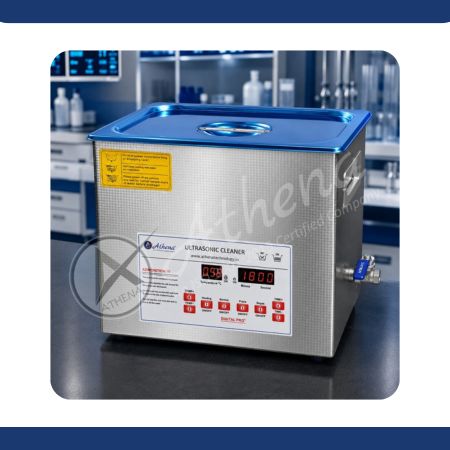
An ultrasonic cleaning machine typically consists of:
- A stainless steel tank
- Ultrasonic transducers
- Digital controls
- Temperature regulation
- Timer settings
Unlike manual cleaning methods, ultrasonic cleaning technology delivers uniform cleaning efficiency across all immersed components. This makes it highly suitable for precision instrument cleaning and scientific instrument cleaning applications.
Why Precision Instruments Require Advanced Cleaning
Precision instruments contain intricate surfaces, narrow passages, and sensitive components that require careful handling. Residues from chemicals, biological materials, oils, dust, or manufacturing debris can compromise instrument performance and calibration accuracy.
Manual cleaning creates several operational challenges:
- Inconsistent cleaning results
- Risk of scratching sensitive surfaces
- Difficulty cleaning internal cavities
- Increased labour requirements
- Higher exposure to chemical cleaning agents
Laboratory environments also demand strict laboratory hygiene standards. In pharmaceutical and medical settings, inadequate cleaning may contribute to contamination risks and regulatory non-compliance.
A laboratory ultrasonic cleaner addresses these issues by delivering controlled and repeatable cleaning cycles. The process cleans delicate instruments safely while reducing direct handling by technicians.
Key Benefits of Ultrasonic Cleaning
Superior Cleaning Accuracy
Ultrasonic cleaning reaches areas that brushes, wipes, or compressed air cannot access. Cavitation cleaning penetrates narrow tubing, joints, grooves, and microscopic crevices effectively.
This level of cleaning accuracy is particularly important for:
- Medical instrument cleaning
- Precision engineering components
- Laboratory glassware
- Electronic assemblies
- Scientific testing equipment
- Oil and Industrial Parts
- Automotive Industry
- To remove Grease and oil
The result is residue-free cleaning with minimal risk of surface damage.
Reduced Manual Effort
Traditional precision instrument cleaning often consumes significant technician time. Manual scrubbing also increases the possibility of inconsistent cleaning outcomes.
An ultrasonic cleaning system automates much of the process. Operators simply prepare the cleaning solution, load the instruments, and select the required cleaning cycle. This improves operational efficiency while reducing repetitive manual work.
Safe Cleaning for Delicate Instruments
Many laboratory and medical instruments contain fragile surfaces or precision-machined parts. Aggressive cleaning methods may damage coatings, alter tolerances, or affect calibration accuracy.
Ultrasonic cleaning technology provides non-abrasive cleaning that protects delicate components while still removing contaminants effectively. This makes ultrasonic cleaner for laboratory applications particularly valuable in research and analytical environments.
Faster Cleaning Cycles
Laboratories and industrial facilities often operate under strict production or testing schedules. Delays caused by lengthy cleaning procedures can affect workflow efficiency.
An industrial ultrasonic cleaner significantly reduces cleaning time compared with conventional soaking and scrubbing methods. Multiple instruments can also be cleaned simultaneously, improving throughput in busy facilities.
Consistent and Repeatable Results
Consistency remains essential in regulated industries such as pharmaceuticals and healthcare. Ultrasonic cleaning systems deliver repeatable cleaning performance across every cycle.
Digital timer settings and temperature control help maintain standardised cleaning procedures, which supports quality assurance and laboratory equipment maintenance programmes.
Improved Laboratory Hygiene and Equipment Lifespan
Regular contamination removal reduces the accumulation of residues that may contribute to corrosion, wear, or microbial growth. Cleaner instruments perform more reliably and maintain calibration accuracy for longer periods.
Proper ultrasonic cleaning supports:
- Better laboratory hygiene
- Reduced equipment downtime
- Longer instrument lifespan
- Lower maintenance costs
Applications Across Industries
Ultrasonic cleaning systems support a wide range of industrial and laboratory applications because they combine precision, speed, and operational safety.
Common sectors using ultrasonic cleaning equipment include:
- Laboratories and research facilities for scientific instrument cleaning
- Pharmaceutical manufacturing for contamination-sensitive processes
- Hospitals and diagnostic centres for medical instrument cleaning
- Electronics manufacturing for cleaning circuit boards and sensitive assemblies
- Jewellery and precision engineering industries for detailed component cleaning
The flexibility of ultrasonic cleaning machines makes them suitable for both small-scale laboratory operations and larger industrial cleaning processes.
Features to Look for in an Ultrasonic Cleaner
Selecting the correct ultrasonic cleaner depends on the application, cleaning volume, and instrument sensitivity. Facilities should assess both cleaning performance and long-term reliability before investing in equipment.
Important features include:
- Stainless steel tank construction for durability and corrosion resistance
- Adjustable temperature control for optimised cleaning performance
- Digital timer settings for process consistency
- Appropriate tank capacity based on workload
- Energy-efficient operation for continuous industrial use
- Reliable ultrasonic frequency output for precision cleaning
Athena Instruments offers a range of ultrasonic cleaning machine solutions suitable for laboratories, hospitals, manufacturing facilities, and industrial operations. Their systems support effective cleaning delicate instruments while maintaining operational reliability.
Laboratories and industrial buyers can explore the complete range of ultrasonic cleaners from Athena Instruments for different cleaning applications and capacity requirements.
Why Choose Athena Instruments Ultrasonic Cleaners
Athena Instruments ultrasonic cleaners are designed for demanding laboratory and industrial environments where cleaning precision and reliability remain critical.
Their ultrasonic cleaning systems support precision cleaning equipment requirements across multiple sectors by combining robust engineering with practical operational features.
Key advantages include:
- Industrial-grade stainless steel construction
- Stable ultrasonic performance
- User-friendly digital controls
- Reliable cleaning efficiency
- Suitability for continuous laboratory use
- Technical support and product expertise
Athena Instruments focuses on delivering dependable ultrasonic cleaning solutions that meet the needs of laboratories, research centres, healthcare facilities, and industrial users. Their equipment supports consistent scientific instrument cleaning while helping organisations maintain high operational standards.
The Future of Precision Cleaning in Laboratories and Industry
Modern laboratories and precision industries require cleaning methods that are accurate, repeatable, and safe for sensitive equipment. Ultrasonic cleaning technology provides an efficient solution for contamination removal while protecting delicate instruments and improving laboratory hygiene.
By using high-frequency sound waves and cavitation cleaning, ultrasonic cleaners deliver superior cleaning performance in areas that manual methods cannot effectively reach. The result is improved cleaning efficiency, reduced manual effort, and extended instrument lifespan.
For organisations seeking reliable precision cleaning equipment, Athena Instruments offers industrial ultrasonic cleaner solutions designed for laboratory and industrial applications. Businesses can review the available ultrasonic cleaning solutions for laboratories and industrial applications to identify suitable systems for their operational requirements.