


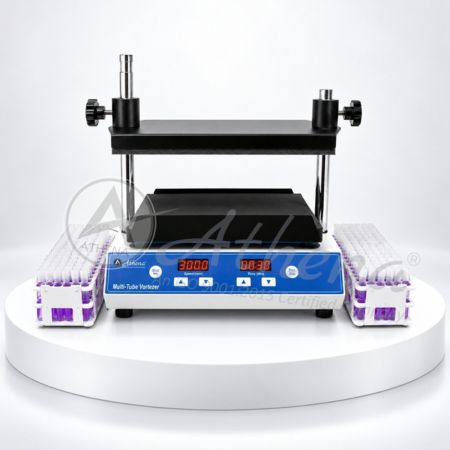
Food and beverage testing laboratories often handle multiple samples that require controlled mixing before analysis. Preparing each tube individually can add repetitive handling, particularly when laboratories work with larger batches or routine quality-testing workflows.
A Multi Tube Vortex Shaker enables several samples to be agitated simultaneously under controlled operating conditions. For laboratories involved in food and beverage sample preparation, this approach can support organized batch processing while allowing technicians to select mixing conditions appropriate to their methods, sample matrices, and tube formats.
What Is a Multi Tube Vortex Shaker?
A multi-tube vortex shaker is laboratory equipment designed to agitate multiple sample tubes simultaneously using orbital motion. Unlike a conventional single-tube vortex mixer, a multi-tube system uses a rack or holder to secure several tubes during the same mixing cycle.
Depending on the instrument, users can control parameters such as rotational speed, mixing duration, and operating mode. This makes multi-tube vortexing useful when a laboratory needs to process batches under defined conditions rather than manually mixing individual tubes one after another.
The required settings still depend on factors such as sample characteristics, tube dimensions, volume, and the analytical procedure being followed.
Why Multi-Tube Vortex Mixing Matters in Food and Beverage Testing
Sample preparation is an important stage in many food and beverage testing workflows. Laboratories may need to mix samples or suspensions before subsequent analytical steps associated with quality analysis, contaminant testing, or routine laboratory evaluation.
A multi-tube vortex mixer allows compatible samples to be processed as a batch. This can reduce repetitive one-at-a-time vortexing and help technicians manage workflows where numerous samples require similar preparation conditions.
Improving High-Throughput Sample Preparation
High-throughput laboratories benefit from equipment that can accommodate their typical batch sizes. Simultaneous tube mixing allows technicians to place multiple compatible samples into an appropriate rack and run them for a defined period.
The objective is not simply higher speed. Laboratories need suitable control over mixing intensity, duration, tube configuration, and operating mode. Conditions should always correspond to the laboratory’s analytical method, SOP, sample matrix, and required preparation procedure.
Key Features to Evaluate in a Multi Tube Vortex Shaker
Selecting a vortex shaker requires more than comparing maximum rpm. The equipment should match the tubes, samples, batch sizes, and mixing procedures routinely used by the laboratory.
Important considerations include:
- Speed and orbital motion: Adjustable speed helps laboratories select mixing intensity for different preparation requirements, while orbital amplitude influences the agitation pattern.
- Timer and operating modes: Timed operation and continuous or pulse modes provide greater control over how samples are mixed.
- Rack compatibility and capacity: Tube diameter, sample volume, and normal batch size should be matched with the correct rack.
- Load and operating conditions: Maximum permissible load and environmental specifications should suit the intended laboratory workflow.
Digital controls can also make it easier to set operating parameters consistently across routine batches.
Athena Instruments Multi-Tube Vortexer: Technical Overview
The Athena Instruments Multi-Tube Vortexer, model ATMT-2500, is designed for simultaneous sample agitation and homogenization. According to Athena Instruments’ product information, the system can process up to 50 tubes at once, depending on the selected tube and rack configuration.
The instrument uses microprocessor-based digital controls and supports both continuous and pulse operation. Its specifications provide laboratories with adjustable parameters for different sample-preparation requirements.
| Specification | Athena ATMT-2500 |
| Speed Range | 500–2500 rpm |
| Orbital Amplitude | 4 mm |
| Timing Range | 1 sec–9999 min |
| Maximum Load | 5 kg |
| Power | 60 W |
| Speed Accuracy | ±10 rpm |
| Pulse Interval | 1–10 sec |
| Operating Temperature | 4°C–45°C |
| Relative Humidity | ≤70% |
| Mixing Modes | Continuous and pulse |
| Tube Processing | Up to 50 tubes, configuration dependent |
These parameters are particularly relevant when laboratories need controlled mixing while handling multiple samples within the same workflow.
Tube and Rack Compatibility for Different Laboratory Workflows
Tube compatibility is an important consideration because laboratory samples are not always prepared in the same vessel size. Athena Instruments lists rack configurations for 10 mm, 12 mm, 13 mm, 15/16 mm, 25 mm, and 50 ml tubes, along with a tray-pad configuration.
Several smaller tube-rack configurations can accommodate up to 50 tubes, while larger formats have different capacities. Laboratories should therefore confirm their tube dimensions, required capacity, and appropriate rack before selecting a configuration rather than assuming every rack supports 50 samples.
Choosing a Multi Tube Vortex Shaker for a Food Testing Laboratory
A suitable instrument should fit the laboratory’s established process rather than simply provide the highest available speed or capacity. Before choosing equipment, laboratories should assess their normal sample volumes, tube diameters, average batch sizes, mixing durations, and required agitation intensity.
Rack availability also deserves attention when a facility works with several vessel formats. Continuous and pulse operation may be useful when methods call for different mixing patterns.
Most importantly, the selected settings and configuration should remain consistent with the analytical procedure or laboratory SOP being used.
Supporting Efficient Food and Beverage Sample Preparation
For laboratories processing multiple samples, a Multi Tube Vortex Shaker provides a practical way to perform controlled batch agitation without relying exclusively on individual tube-by-tube mixing. Capacity, speed control, rack compatibility, operating modes, and sample requirements should all be considered when selecting a system.
Food and beverage laboratories evaluating the Athena Instruments ATMT-2500 can contact Athena Instruments to discuss tube sizes, sample volumes, batch requirements, and rack configurations before choosing an appropriate setup.
Frequently Asked Questions
Q1. What is a Multi Tube Vortex Shaker used for?
Answer: A Multi Tube Vortex Shaker is used to agitate multiple laboratory samples simultaneously. It can support batch sample preparation, mixing, and homogenization workflows where compatible tubes need controlled vortexing before subsequent laboratory procedures.
Q2. How many tubes can the Athena Instruments Multi-Tube Vortexer process?
Answer: The Athena Instruments ATMT-2500 is designed to process up to 50 tubes at once, depending on the selected rack and tube configuration. Capacity varies with tube size, so the appropriate rack should be confirmed for the intended workflow.
Q3. What speed range does the Athena ATMT-2500 provide?
Answer: The ATMT-2500 provides an adjustable speed range of 500–2500 rpm. Adjustable speed allows laboratories to select an appropriate mixing intensity based on the sample, vessel, preparation method, and laboratory procedure.
Q4. Can a multi-tube vortex shaker be used in food and beverage testing laboratories?
Answer: Yes. Multi-tube vortex shakers can support food and beverage sample-preparation workflows where controlled agitation of multiple samples is required. Specific mixing conditions should be selected according to the analytical method, sample matrix, and laboratory SOP.