

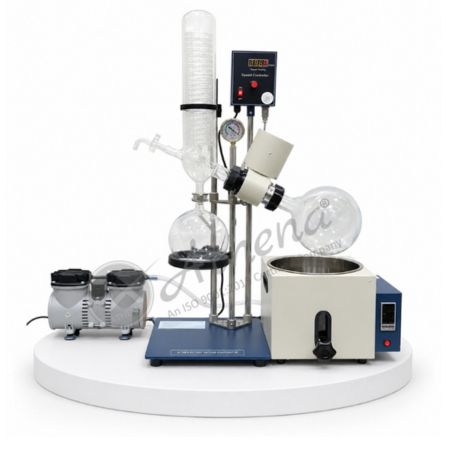
A rotary evaporator is designed to remove solvents efficiently without exposing samples to unnecessarily high temperatures. Yet, if a routine evaporation cycle starts taking longer than expected, the cause may not be the solvent alone. Vacuum instability, insufficient heat transfer, poor condenser performance, incorrect rotation speed, or sample characteristics can all affect the evaporation rate.
Understanding how these variables interact helps laboratory professionals identify the source of slow solvent removal, improve process consistency, and avoid unnecessary adjustments that could compromise sample quality.
How Does a Rotary Evaporator Work?
A rotary evaporator, also known as a rotary vacuum evaporator, combines four operating principles: reduced pressure, controlled heating, flask rotation, and vapour condensation.
The vacuum system lowers the pressure inside the evaporation assembly, reducing the temperature at which the solvent boils. The heating bath transfers energy to the sample, while flask rotation spreads the liquid across a larger surface area. The resulting vapour passes into the condenser, where cooling converts it back into liquid for collection.
These functions are interdependent. A stronger vacuum cannot compensate indefinitely for inadequate heat transfer, and efficient heating is of limited value if the condenser cannot handle the vapour load. Similarly, poor vacuum stability can make an otherwise suitable temperature setting ineffective.
When a rotary evaporator takes too long to remove solvent, troubleshooting should therefore focus on the complete system rather than a single setting.
5 Causes of Slow Solvent Removal in a Rotary Evaporator
1. Insufficient Vacuum or Leakage in the System
Vacuum performance is one of the first factors to investigate. Lower absolute pressure generally allows a solvent to boil at a lower temperature. If the system cannot reach or maintain the intended pressure, evaporation may become slower or require more heat.
For example, a vacuum pump may be operating while a worn flask seal, loose connection, damaged hose, or leaking joint prevents the system from achieving stable operating conditions. A pump can also struggle if its capacity, condition, or compatibility is unsuitable for the application.
Technical checks: Compare the vacuum gauge reading with the intended operating pressure. Inspect accessible seals, tubing, joints, and connections, and follow the manufacturer’s approved leak-testing procedure. Check the pump and its maintenance requirements if the system remains unable to reach the required pressure.
It is also important to distinguish between the pump’s ultimate vacuum rating and the pressure achieved during actual evaporation. The latter depends on the complete assembly, leakage, vapour load, and system configuration.
2. Incorrect Heating Bath Temperature or Insufficient Heat Transfer
The heating bath supplies the energy required to convert liquid solvent into vapour. If the bath temperature is too low for the selected solvent and operating pressure, evaporation may remain slow even when the vacuum system is functioning correctly.
However, simply increasing the bath temperature is not always the right solution. Excessive heating can damage heat-sensitive compounds, encourage bumping, or create unnecessary thermal stress.
Heat transfer also depends on the contact between the sample and the heated flask surface. A large sample volume, poor liquid distribution, or unsuitable flask configuration may affect how effectively energy reaches the liquid.
Technical checks: Verify the actual bath temperature rather than relying solely on the setpoint. Confirm that the flask is immersed appropriately and that the bath maintains a stable temperature under operating conditions. Review the solvent’s boiling behaviour at the selected pressure and consider the sample’s thermal stability before adjusting the temperature.
Athena Instruments’ product information lists heating configurations ranging from 1 kW to 5 kW across the models shown. These are model-specific heating power ratings, not direct measurements of evaporation rate. Actual performance also depends on the solvent, pressure, sample volume, heat transfer, and condenser capacity.
3. Poor Condenser Cooling and Inefficient Solvent Recovery
The condenser must remove enough heat from the solvent vapour to convert it back into liquid. If cooling is inadequate, condensation may become less effective, solvent recovery can decline, and vapour may pass further into the vacuum system.
Potential causes include insufficient coolant flow, unsuitable coolant temperature, obstructed passages, condenser contamination, or a vapour load that exceeds the practical capacity of the configuration.
This problem deserves particular attention when the system appears to evaporate solvent but the collection flask receives less condensate than expected.
Technical checks: Confirm that coolant is circulating correctly and that the inlet and outlet conditions are consistent with the procedure. Inspect for restrictions or contamination where appropriate, and assess whether the condenser is suitable for the solvent and expected vapour load.
Condenser efficiency is not determined by cooling temperature alone. Heat-transfer area, coolant flow, vapour load, and the properties of the solvent all influence performance.
4. Incorrect Rotation Speed or Excessive Flask Loading
Rotation helps create a thin film of liquid along the inner wall of the evaporation flask. This increases the effective surface area available for heat transfer and evaporation.
If the flask rotates too slowly, liquid distribution may be less effective. If the flask is overfilled, the available surface area relative to the sample volume can decrease, while bumping and foaming may interrupt the process. Excessively high rotation is not automatically beneficial because the appropriate speed depends on flask geometry, sample viscosity, and operating conditions.
Technical checks: Confirm that the sample volume is suitable for the flask, then adjust rotation within the equipment manufacturer’s recommended range. Observe the liquid film and watch for persistent foaming, splashing, or bumping. If the sample load is excessive, reducing the volume per batch may improve process control.
Athena Instruments lists adjustable rotation speed as a technical feature of its rotary vacuum evaporator systems. The useful operating range, however, should always be confirmed for the specific model and application.
5. Solvent Properties, Mixtures, and Sample Composition
Not every slow evaporation cycle indicates a fault with the equipment. Solvent volatility, mixture composition, viscosity, dissolved solids, and sample sensitivity can all change the time required to complete a process.
A single solvent may evaporate relatively quickly under suitable conditions, while a mixture can behave differently as its composition changes. The more volatile component may leave first, leaving behind a liquid with a higher boiling range or lower volatility. Viscous samples and solutions containing substantial dissolved material may also present different heat-transfer and evaporation characteristics.
Technical checks: Confirm the solvent identity and composition, review the sample’s viscosity and thermal sensitivity, and compare the observed behaviour with the expected process. For mixtures, consider whether a staged procedure is appropriate. Avoid applying operating settings from one solvent or sample to another without checking compatibility and process requirements.
How to Troubleshoot a Slow Rotary Evaporator
Use the following table to connect the observed symptom with a practical diagnostic step.
| Observed symptom | Likely area to investigate | Recommended check |
| Vacuum pressure fluctuates or cannot reach the target | Leaks, seals, tubing, or pump performance | Inspect connections and follow the approved leak-test procedure |
| Evaporation is slow despite stable pressure | Heating or heat transfer | Verify bath temperature, flask immersion, and sample loading |
| Vapour is produced but little condensate is collected | Condenser or cooling circuit | Check coolant flow, temperature, and condenser suitability |
| Liquid distribution is uneven or bumping occurs | Rotation speed or flask loading | Review speed, fill level, and sample behaviour |
| Evaporation slows as the batch progresses | Changing mixture composition or sample properties | Review solvent volatility and the remaining liquid composition |
For a more reliable diagnosis, change one operating variable at a time and record the pressure, bath temperature, rotation speed, and approximate evaporation time. This makes it easier to compare runs and determine whether the adjustment actually improves performance.
Never compensate for a suspected leak simply by increasing heat. Follow the equipment manual, use vacuum-compatible components, and apply appropriate precautions when handling volatile, flammable, or hazardous solvents.
Can the Rotary Evaporator Configuration Affect Performance?
Yes. Equipment selection matters when a laboratory regularly processes large batches, works with different solvents, or handles temperature-sensitive samples.
Athena Instruments’ product information shows models with flask capacities ranging from 1 L to 50 L, heating power from 1 kW to 5 kW, and different condenser and lift configurations. The listed models include manual and optional automatic lift arrangements, depending on the model.
These differences help laboratories evaluate equipment against their application requirements, but a larger flask or higher heating power does not automatically guarantee faster solvent removal. The vacuum system, condenser capacity, solvent properties, batch volume, and operating conditions must work together.
When evaluating a rotary vacuum evaporator, consider the required batch size, expected solvent throughput, target pressure, heating requirements, condenser performance, and sample sensitivity. Selecting a configuration around these factors is more useful than comparing a single specification in isolation.
Need Help Selecting a Rotary Vacuum Evaporator?
If your laboratory continues to experience slow solvent removal despite checking the operating conditions, it may be worth reviewing the equipment configuration against your process requirements.
Athena Instruments provides rotary vacuum evaporator options for laboratory and industrial applications. To discuss flask capacity, heating requirements, vacuum performance, condenser configuration, and application suitability, visit Athena Instruments and submit your laboratory requirements for further discussion.
Frequently Asked Questions
Why is my rotary evaporator not reaching the expected evaporation rate?
Check vacuum stability, bath temperature, condenser cooling, flask loading, and solvent properties. Compare actual operating conditions with the requirements of the specific solvent and sample before concluding that the equipment has a fault.
Does a stronger vacuum always make solvent removal faster?
Not necessarily. Lower pressure can reduce a solvent’s boiling temperature, but evaporation also depends on heat input, vapour removal, condenser performance, and sample characteristics. The best pressure is the one that supports efficient, controlled operation for the particular process.
How does condenser cooling affect solvent recovery?
The condenser removes heat from solvent vapour so it can return to liquid form. Inadequate cooling can reduce condensation efficiency and solvent recovery. Appropriate coolant conditions and sufficient condenser capacity are important for the expected vapour load.
When should a rotary evaporator be assessed by a technician?
Seek a qualified technical assessment if the system cannot maintain the required vacuum, components appear damaged, cooling performance remains inadequate, or repeated troubleshooting does not resolve the problem. Persistent performance issues should be investigated before continuing to operate outside recommended conditions.