

Ultrasonic sonication is widely used in laboratories for sample preparation, cleaning, homogenization, degassing, emulsification, and other processing applications. However, ultrasonic energy does not only create cavitation. It can also raise the temperature of the sample, particularly during extended or high-power operation.
For temperature-sensitive samples, uncontrolled heating can affect sample stability, alter reaction conditions, or reduce the consistency of results. The solution is not necessarily to avoid sonication but to manage the energy, time, and temperature throughout the process.
Here are practical laboratory techniques for performing ultrasonic sonication without overheating.
Why Does Ultrasonic Sonication Generate Heat?
During sonication, ultrasonic waves create rapid pressure changes in a liquid. These pressure changes produce microscopic bubbles that form and collapse during acoustic cavitation. This process transfers mechanical energy into the sample.
Some of that energy ultimately becomes heat.
The temperature rise depends on several factors, including ultrasonic power, sonication duration, sample volume, vessel configuration, starting temperature, and the physical properties of the material being processed.
Continuous operation at high power can therefore cause the sample temperature to increase faster than expected.
For biological samples, pharmaceutical formulations, polymers, and other temperature-sensitive materials, monitoring this increase is particularly important.
6 Practical Ways to Prevent Overheating During Sonication
1. Use Pulsed Sonication Instead of Continuous Operation
One of the simplest techniques is to operate the ultrasonic system in cycles rather than continuously.
A pulse allows the system to deliver ultrasonic energy for a defined period before stopping briefly. During the off period, heat can dissipate from the sample.
For example, instead of running one long continuous cycle, a laboratory protocol may divide the required sonication time into shorter intervals. The exact cycle depends on the sample and equipment, so the method should be validated for the application.
Pulsed operation can be particularly useful when processing samples that are sensitive to temperature changes.
2. Monitor Sample Temperature Regularly
Temperature should be treated as a process parameter, not an afterthought.
Before starting ultrasonic sonication, record the initial sample temperature. Continue checking the temperature during processing, particularly when developing a new protocol.
A practical approach is to establish a maximum acceptable sample temperature and pause the process if that limit is approached.
Temperature monitoring is especially important when working with:
- Proteins, enzymes, and biological samples
- Pharmaceutical formulations
- Volatile or temperature-sensitive compounds
- Polymer dispersions
- Samples requiring controlled experimental conditions
The appropriate temperature limit should come from the requirements of the specific material or experimental protocol.
3. Reduce Ultrasonic Exposure When Possible
More ultrasonic power does not automatically mean better processing.
Excessive energy can increase heating while providing little additional benefit once the required level of dispersion, mixing, extraction, or homogenization has been achieved.
Start by determining the minimum effective sonication time and power required for the application. Record the resulting temperature and processing outcome, then optimize the parameters systematically.
This approach can improve reproducibility while reducing unnecessary thermal exposure.
4. Use External or Integrated Cooling
For applications where temperature must remain within a defined range, passive cooling may not be sufficient.
An ultrasonic bath equipped with a cooling system can remove heat as it develops during operation. This makes active temperature control useful for longer processing cycles and temperature-sensitive laboratory applications.
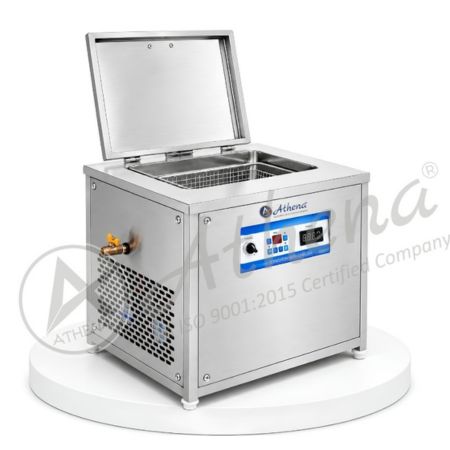
Athena Instruments‘ Ultrasonic Sonicator with Chiller is designed around this requirement. According to the product specifications shown, the system provides active temperature control between 5°C and 25°C, with an integrated closed-loop chiller.
The equipment is available in configurations ranging from 10 L to 50 L, with ultrasonic frequencies of 40 kHz and different ultrasonic power options depending on the model.
This type of temperature-controlled ultrasonic system can be considered when maintaining a stable processing environment is more important than simply delivering ultrasonic energy.
Choosing Sonication Parameters for Better Temperature Control
| Parameter | Effect on Heating | Practical Approach |
| Ultrasonic power | Higher power can increase heat generation | Use the lowest effective power |
| Sonication time | Longer exposure generally increases heat | Use validated processing times |
| Pulse cycle | Provides cooling periods | Use intermittent cycles when suitable |
| Starting temperature | Affects the available thermal margin | Begin within the required range |
| Cooling | Removes accumulated heat | Use active cooling for demanding applications |
These parameters should be optimized together rather than adjusted independently. A change in power, for example, may require a corresponding change in sonication time or pulse duration.
Why Degassing Can Also Matter
Dissolved gases in a liquid can influence cavitation behavior. Many ultrasonic systems therefore provide a degassing function before or during processing.
Athena Instruments’ ultrasonic sonicator includes an auto degassing mode with a pre-programmed cycle. The purpose is to help prepare the liquid for more consistent ultrasonic operation.
Degassing should not, however, be treated as a universal solution for overheating. Temperature management still depends on controlling ultrasonic energy and removing accumulated heat.
When Should a Laboratory Consider a Sonicator With a Chiller?
A conventional ultrasonic bath may be sufficient for short, low-intensity applications where temperature rise is not critical. Active cooling becomes more relevant when the laboratory needs longer processing periods or tighter control over sample temperature.
A temperature-controlled ultrasonic sonicator may be appropriate when:
- Sample integrity depends on maintaining a defined temperature range.
- Sonication cycles are long enough to produce significant heat.
- The process requires repeatable thermal conditions.
- Multiple samples need consistent treatment.
- Cooling is difficult to manage manually.
Athena Instruments’ system combines ultrasonic processing with an integrated chiller, SS304 construction, PZT transducers, digital microcontroller, and automatic degassing features. The product is intended for laboratory environments including analytical, pharmaceutical and biotechnology, semiconductor, medical, and R&D applications.
Build a Temperature-Controlled Sonication Protocol
Preventing overheating is ultimately about making temperature part of the experimental method.
Record the sample volume, starting temperature, ultrasonic power, frequency, cycle duration, total sonication time, and cooling conditions. Then evaluate the final sample temperature alongside the desired processing result.
This creates a repeatable protocol rather than relying on an assumption that a particular sonication setting will work for every sample.
For laboratories handling temperature-sensitive materials, ultrasonic sonication with active temperature management can provide greater control over both processing conditions and sample integrity.
Controlled Sonication Starts With the Right Process
Effective ultrasonic processing is not simply about applying more ultrasonic energy. It requires a balance between power, exposure time, cavitation, sample temperature, and cooling.
When overheating could compromise the sample or experimental result, active temperature control provides an additional level of process management.
Athena Instruments provides ultrasonic sonication equipment designed for laboratory applications where controlled processing conditions matter. If your application involves temperature-sensitive samples or extended ultrasonic processing, you can contact Athena Instruments to discuss the appropriate configuration.
Frequently Asked Questions
Q1. Can ultrasonic sonication damage heat-sensitive samples?
Answer: Yes. Prolonged or high-power sonication can increase sample temperature and may affect temperature-sensitive materials. Temperature monitoring and controlled sonication parameters can help reduce this risk.
Q2. How can I keep a sample cool during sonication?
Answer: Use shorter or pulsed cycles, monitor the sample temperature, optimize ultrasonic power, and use an appropriate cooling system. For demanding applications, an ultrasonic sonicator with an integrated chiller can provide active temperature control.
Q3. Is a chiller necessary for every ultrasonic bath?
Answer: No. The need for active cooling depends on the application, processing time, sample sensitivity, power level, and required temperature range.
Q4. What temperature should a sample be during sonication?
Answer: There is no single temperature suitable for every application. The target range should be determined by the stability and requirements of the specific sample and laboratory procedure.