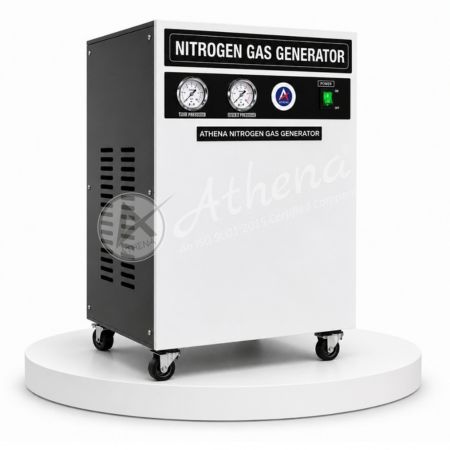


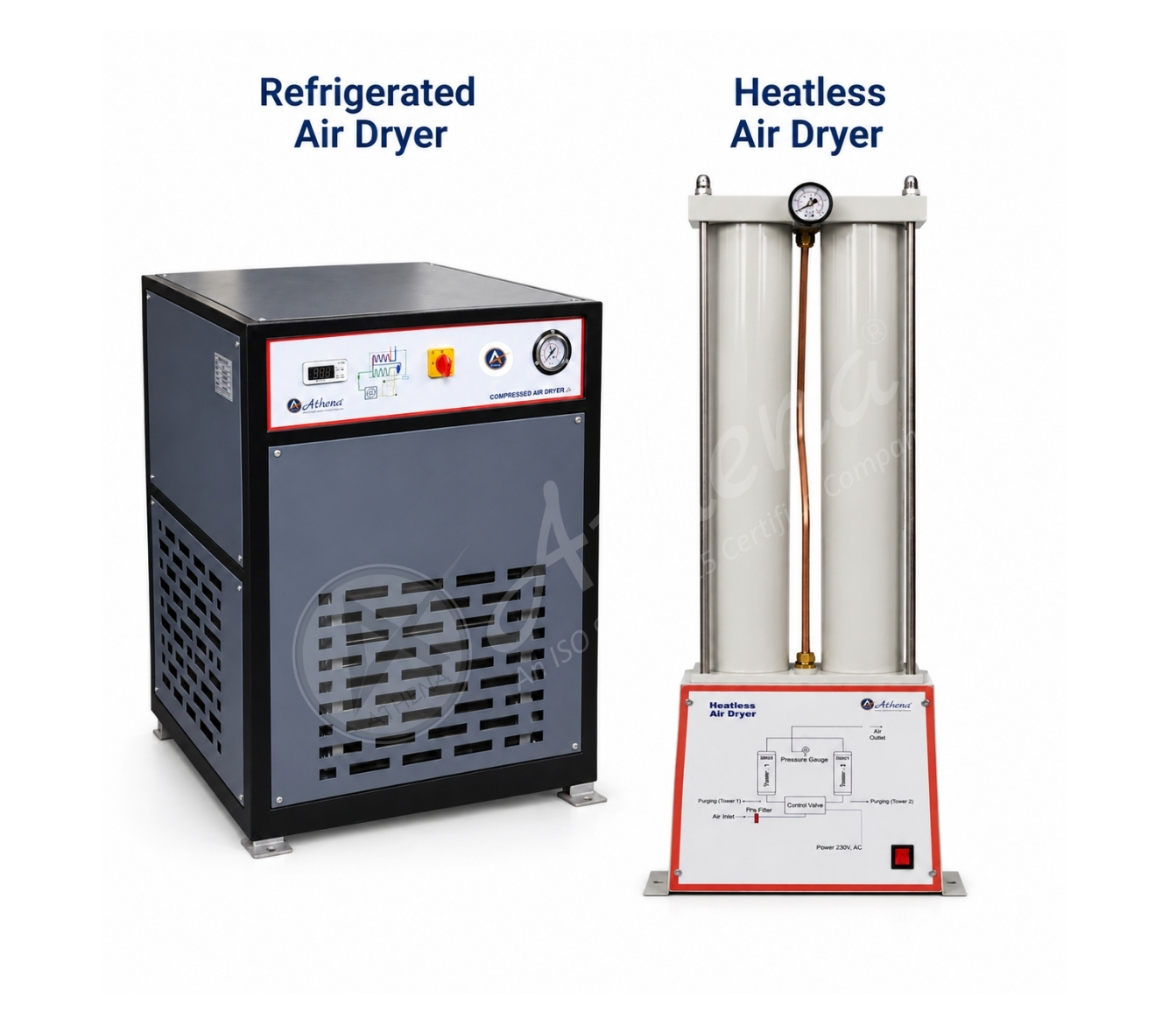
Nitrogen generators depend on a reliable supply of clean, dry compressed air. When moisture enters the air treatment system, it can affect downstream equipment, reduce process reliability, and create maintenance issues. For plants using PSA nitrogen generation, selecting the right air dryer is therefore an important part of compressed-air preparation.
Two common technologies are a refrigerated air dryer and a Heatless Air Dryer. Both remove moisture, but they work differently and are suited to different operating requirements.
Why Does Compressed Air Need Drying Before Nitrogen Generation?
Atmospheric air naturally contains water vapour. When air is compressed, the concentration of moisture increases and some of that water condenses as the compressed air cools.
If this moisture is not removed, it can travel toward the nitrogen generator and other pneumatic equipment. Depending on the application, excess moisture can contribute to corrosion, contamination, condensate accumulation, and unstable operating conditions.
For PSA nitrogen generators, properly treated compressed air helps protect the adsorbent material and supports consistent operation. The required level of drying, however, depends on the nitrogen-generation system and the manufacturer’s specifications.
This is where choosing between a refrigerated air dryer and a heatless air dryer becomes relevant.
How Does a Refrigerated Air Dryer Work?
A refrigerated air dryer cools compressed air to a controlled temperature. As the air temperature falls, moisture condenses and can then be separated and removed through a condensate drainage system.
The dried compressed air is subsequently reheated before leaving the dryer in many system designs, reducing the risk of external condensation in downstream piping.
Refrigerated dryers are commonly used where a moderate pressure dew point is sufficient and where continuous, energy-conscious compressed-air drying is required.
Where Is a Refrigerated Air Dryer Useful?
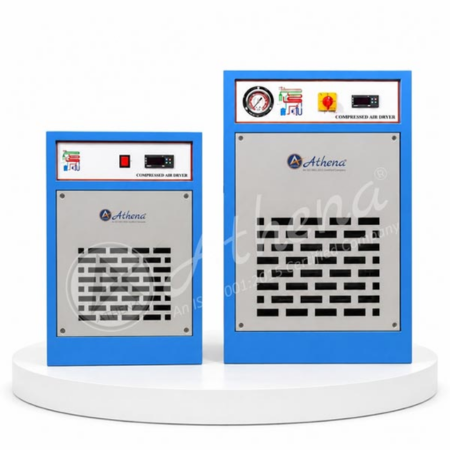
A refrigerated dryer can be appropriate for general industrial compressed-air systems, instrumentation, and applications where extremely low pressure dew points are not required.
Athena Instruments’ Refrigerated Air Dryer range is designed for compressed-air moisture removal across industrial and instrumentation applications. The product range shown by Athena includes ATRD models with capacities ranging from approximately 25 CFM to 2,000 CFM, along with a separate high-pressure series.
The product page highlights features including efficient moisture removal, energy-efficient refrigeration, low pressure drop, automatic condensate drainage and consistent dew-point performance.
What Is a Heatless Air Dryer?
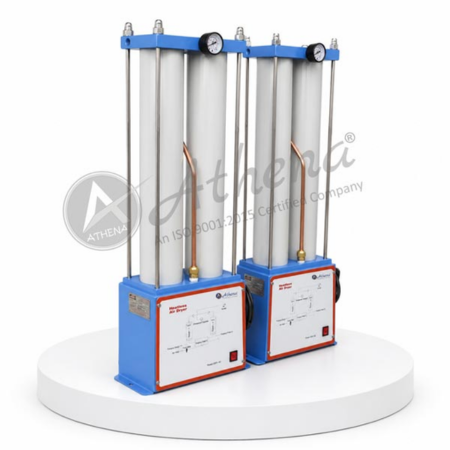
A Heatless Air Dryer, also called a heatless desiccant dryer, uses an adsorbent material to remove water vapour from compressed air.
Instead of cooling the air to condense moisture, the desiccant captures moisture through adsorption. A portion of the dried compressed air is typically used to regenerate the saturated desiccant bed, allowing the dryer to continue operating through alternating adsorption and regeneration cycles.
The major advantage is the ability to achieve a much lower pressure dew point than a typical refrigerated dryer. This can make heatless desiccant drying useful when the nitrogen-generation process or downstream application has stringent moisture requirements.
The trade-off is that regeneration consumes a portion of compressed air, which can affect the overall energy efficiency of the system.
Refrigerated Air Dryer vs Heatless Air Dryer
The right choice depends less on the dryer name and more on the required pressure dew point, compressed-air conditions and nitrogen-generation process.
| Factor | Refrigerated Air Dryer | Heatless Air Dryer |
| Drying principle | Cooling and condensation | Desiccant adsorption |
| Typical purpose | General compressed-air drying | Deep drying where low dew point is required |
| Pressure dew point | Moderate | Very low |
| Regeneration air | Not normally required for desiccant regeneration | Required |
| Energy consideration | Generally efficient for moderate drying requirements | Higher compressed-air consumption can occur |
| Typical application | Industrial and instrumentation air | Critical processes requiring very dry air |
For a nitrogen generation system, the equipment manufacturer’s recommended air quality should always be checked before selecting the dryer.
Which Air Dryer Is Better for Nitrogen Generation?
There is no universal answer.
If the nitrogen generator can operate with the pressure dew point delivered by a Refrigerated Air Dryer, refrigeration-based drying can provide an efficient approach to removing bulk moisture from compressed air.
When the process requires a substantially lower dew point, a Heatless Air Dryer may be more appropriate because desiccant technology can dry compressed air to much lower moisture levels.
The decision should consider the nitrogen generator’s specifications, compressor capacity, operating pressure, ambient conditions, required nitrogen purity, dew-point requirement and the cost of regeneration air.
A practical approach is to determine the required pressure dew point first, then select the drying technology that can reliably meet it.
What Should You Check Before Selecting a Compressed Air Dryer?
Before choosing a dryer for nitrogen generation, review the complete operating conditions rather than selecting a model based only on compressor capacity.
Key parameters include:
- Compressed-air flow rate and peak demand
- Operating pressure and inlet temperature
- Required pressure dew point
- Ambient temperature and cooling conditions
- Nitrogen generator manufacturer’s air-quality requirements
Athena Instruments’ Refrigerated Air Dryer range includes multiple capacity and pressure configurations, making the operating conditions particularly important when selecting the appropriate model.
Why Proper Air Drying Improves System Reliability
Moisture control is part of overall compressed-air treatment. Removing water before it reaches sensitive downstream equipment can help reduce condensate-related problems and maintain more stable operating conditions.
For nitrogen generation, this becomes especially relevant because the compressed air is the feedstock for the separation process. A suitable dryer, combined with appropriate filtration and condensate management, helps create the air-quality conditions required by the nitrogen generation system.
The objective is not simply to choose the driest possible air. It is to achieve the required air quality reliably without creating unnecessary operating costs.
Choosing the Right Air Drying Solution
A well-designed nitrogen generation system starts with appropriate compressed-air treatment. Refrigerated Air Dryers and Heatless Air Dryers solve different moisture-control requirements, so the correct choice should be based on pressure dew point, operating conditions and the nitrogen generator’s specifications.
Athena Instruments provides refrigerated compressed-air drying solutions for industrial and instrumentation applications, with the ATRD range covering multiple flow capacities and configurations.
If you are evaluating an air dryer for a nitrogen generation system, share your compressed-air flow, operating pressure and required dew point with Athena Instruments to determine the appropriate configuration.
Frequently Asked Questions
Q1. Can a refrigerated air dryer be used with a nitrogen generator?
Answer: It can be used when the nitrogen generator’s specified compressed-air quality and pressure dew point requirements are compatible with refrigerated drying. Always verify the required air conditions with the nitrogen generator manufacturer.
Q2. Is a heatless air dryer better than a refrigerated air dryer?
Answer: Not in every application. A heatless desiccant dryer can achieve a lower pressure dew point, while a refrigerated dryer can be a practical choice for applications requiring moderate moisture removal. The required dew point should determine the selection.
Q3. What is the main purpose of an air dryer in nitrogen generation?
Answer: The main purpose is to remove moisture from compressed air before it enters downstream equipment or the nitrogen-generation process. The required degree of drying depends on the system design and operating requirements.
Q4. How do I select the right air dryer capacity?
Answer: Start with the actual compressed-air flow, operating pressure, inlet temperature and required pressure dew point. Selecting a dryer only from the compressor’s nominal capacity can result in an unsuitable system.