

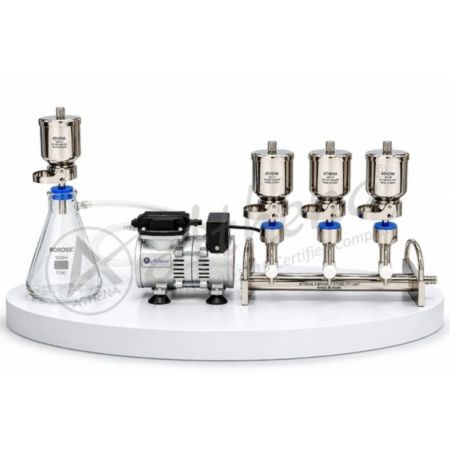
Sterility testing in pharmaceutical laboratories requires more than a single instrument. Depending on the test method and laboratory procedure, the setup can include membrane filtration equipment, filter holders, funnels, manifolds, vacuum filtration components, and other microbiological laboratory equipment.
For filtration-based testing, the equipment needs to work together as part of a controlled laboratory workflow. Understanding the purpose of each component can help laboratories select equipment that is appropriate for their testing method and validated procedures.
What Equipment Is Used for Sterility Testing?
The equipment used depends on the nature of the product being tested and the applicable sterility-testing method. Two established approaches include membrane filtration and direct inoculation.
Membrane filtration is particularly relevant when the sample can be filtered without adversely affecting the microorganisms that the test is intended to detect. In this type of setup, filtration equipment supports the movement of the test sample through a membrane, after which the membrane can be handled according to the laboratory’s validated testing procedure.
A typical filtration-based setup may include a membrane filter, membrane filter holder, filtration funnel, vacuum source and manifold. The exact configuration can vary between laboratories.
The important point is that individual components should not be viewed in isolation. Their compatibility with the laboratory’s established workflow, cleaning practices and testing procedure needs to be considered together.
Key Equipment Used in Membrane Filtration
Sterility Testing Manifold
A sterility testing manifold is designed to form part of a multi-component filtration arrangement. A manifold can provide a connection between filtration positions and the associated vacuum or collection system, depending on its design.
For laboratories handling multiple filtration operations, the configuration of the manifold can be an important consideration because it can affect how the filtration setup is arranged and operated.
Athena Instruments offers a dedicated Sterility Testing Manifold for laboratories evaluating equipment for this type of application.
The appropriate configuration should always be selected according to the laboratory’s validated process rather than simply choosing equipment based on the number of branches or connections.
Membrane Filter Holder Assembly
A membrane filter holder supports the membrane during filtration and forms an important part of a membrane-filtration setup.
The holder needs to work appropriately with the laboratory’s selected membrane and filtration arrangement. Its role becomes particularly relevant when the laboratory needs a controlled and repeatable way to position the membrane during the filtration process.
Athena Instruments provides a Membrane Filter Holder Assembly as part of its laboratory filtration equipment range.
Vacuum Filtration Manifolds and Funnels
Vacuum-assisted filtration can be used in laboratory workflows where a vacuum is applied to facilitate the movement of liquid through a filter.
Depending on the required configuration, laboratories may use individual filtration units or multi-position arrangements. Athena Instruments offers products such as its Laboratory Stainless Steel Funnel Vacuum Filtration 3-Way Manifolds and Multi-Branch Funnel Filter Lab Manifolds.
These products should be evaluated according to the specific filtration application and laboratory requirements rather than being treated as universally interchangeable sterility-testing systems.
How Do These Components Fit Into the Testing Workflow?
In a membrane-filtration approach, the sample is introduced into an appropriate filtration setup, where the liquid passes through a suitable membrane under the conditions established by the laboratory’s validated procedure.
The filter holder supports the membrane, while the funnel provides the sample-entry area and a manifold can allow multiple filtration positions to be arranged within a single setup. A vacuum system may assist liquid movement through the membrane.
After filtration, the membrane and subsequent microbiological examination are handled according to the applicable testing procedure. This is why equipment selection is only one part of the overall process. Laboratory controls, aseptic practices, validated methods and applicable pharmacopoeial requirements also remain important.
The specific procedure should not be inferred from the equipment alone.
What Should You Consider When Selecting Sterility Testing Equipment?
Laboratories evaluating filtration equipment should begin with their testing method and existing workflow rather than choosing a product solely by appearance or configuration.
Important considerations can include the type of filtration being performed, the required number of filtration positions, the membrane and filtration components being used, material requirements, cleaning and handling practices, and compatibility with the laboratory’s validated process.
The supplier’s technical documentation is also worth reviewing. Where equipment will form part of a pharmaceutical quality-control workflow, laboratories should ensure that the selected configuration is appropriate for their own procedures and applicable requirements.
For example, a laboratory performing multiple filtration operations may have different equipment requirements from one using a single-position setup. The correct choice therefore depends on the application rather than a universal equipment list.
Athena Instruments Sterility Testing and Filtration Equipment
Athena Instruments provides a range of laboratory equipment covering filtration and sterility-testing-related applications.
Its range includes the Sterility Testing Manifold, Membrane Filter Holder Assembly and several manifold and vacuum-filtration configurations.
For laboratories assessing equipment, reviewing the product’s documented configuration alongside the intended workflow is a practical starting point. Athena Instruments can also be contacted for product information, configuration requirements, and quotation-related enquiries.
Frequently Asked Questions
Is membrane filtration used for pharmaceutical sterility testing?
Yes. Membrane filtration is one established approach to sterility testing and may be appropriate for products that can be filtered under suitable conditions. Its applicability depends on the product and the applicable validated procedure.
What is the difference between sterility testing and sterilization?
Sterility testing is a microbiological test used to assess a sample or product against applicable sterility requirements. Sterilization, in contrast, is a process intended to eliminate viable microorganisms. They are related but serve different purposes.
What factors determine the number of filtration positions required?
The number of positions depends on the laboratory’s workflow, sample-processing requirements, equipment configuration and validated testing procedure. A multi-position manifold may be useful where the laboratory’s process requires multiple filtration arrangements.
Can any laboratory filtration manifold be used for sterility testing?
Not necessarily. Equipment should be evaluated against the intended application, filtration components, laboratory procedures and applicable requirements. A product described as a general laboratory filtration manifold should not automatically be assumed to be suitable for every sterility-testing application.
Where can laboratories find sterility testing and filtration equipment?
Laboratories can review equipment from specialist laboratory-equipment suppliers such as Athena Instruments. The appropriate product should be selected based on the laboratory’s specific workflow and documented equipment requirements.